


Frisco Chose Unity: What the Election Results Really Reveal
Precinct data, voter turnout and community reactions suggest Frisco’s mayoral race became about more than politics—it became a referendum on leadership, civic engagement and the city’s future.
The Frisco mayoral election may ultimately be remembered for something larger than who won.It revealed which communities organized, which voters showed up and how campaign rhetoric can sometimes motivate opponents as much as supporters. While Mark Hill’s victory was built on a broad coalition of voters from across the city, the election also offered a lesson that extends far beyond Frisco:
In local politics, influence is rarely determined by population size alone. It is earned through participation.
The Precincts That Made the Difference
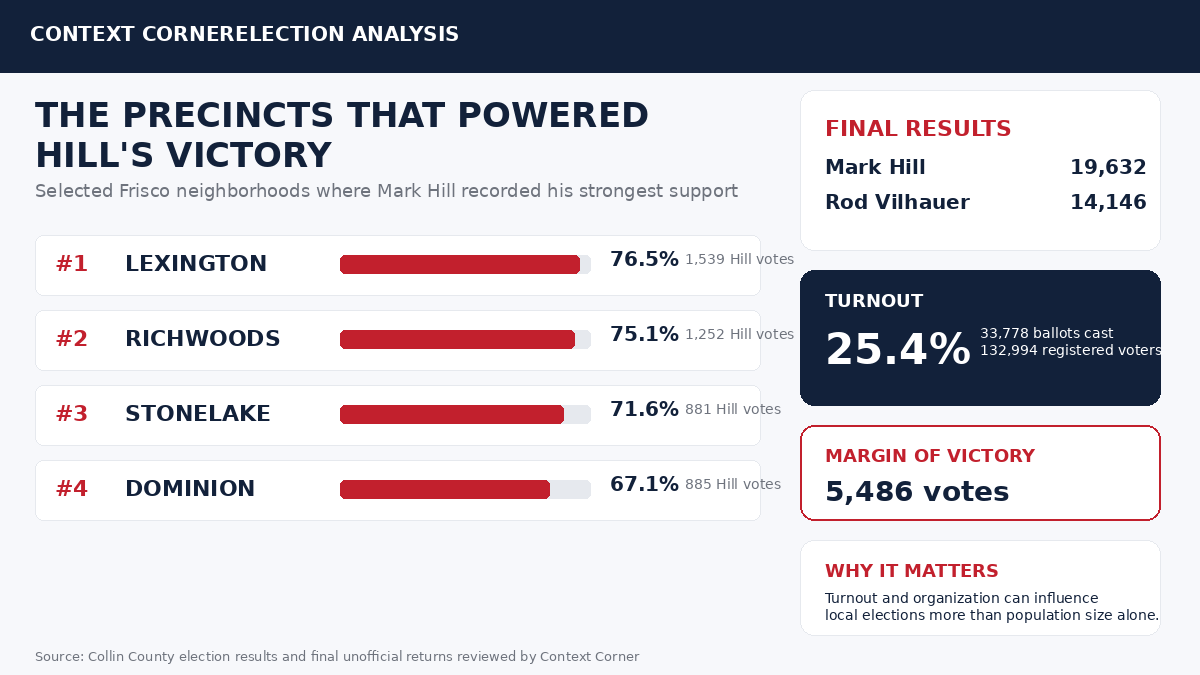
Precinct-level results reviewed by Context Corner reveal some of Hill’s strongest performances came from neighborhoods including Richwoods, Lexington, Stonelake and Dominion. In several of these precincts, Hill received between 67% and 76% of the vote, margins rarely seen in competitive municipal elections.
These same neighborhoods were among the most active throughout the campaign. Residents participated in block walking, phone banking, voter outreach, community education efforts and election-day operations that continued through the final days of the race. Several of these neighborhoods are home to large South Asian and Muslim populations. Community leaders and political observers pointed to unusually high levels of civic engagement and volunteer activity throughout the campaign.
An independent analyst reviewing the results told Context Corner:
“To win large precincts by more than 70 percent is simply not the norm. These neighborhoods organized, volunteered and voted.”
The numbers suggest that organization—not simply demographics—became one of the defining factors of the election.
When Rhetoric Becomes a Motivator
Campaigns often assume that controversial rhetoric energizes supporters. What is discussed less often is how it can energize opponents. Throughout the race, discussions surrounding immigration, Muslims, Sharia-related concerns and demographic change became recurring themes.
Comments made by Rod Vilhauer in interviews, podcasts and public appearances generated significant debate across Frisco.
Several residents interviewed by Context Corner said those comments became a motivating factor in their decision to vote.One voter described campaign messaging directed toward immigrants and Muslims as:
“Disgusting.”
Another described the election as:
“A test of American values.”
Whether voters agreed or disagreed with Vilhauer’s positions, there is evidence that the controversy itself became a factor in increasing voter engagement. Political strategists often refer to this as a backlash effect—when campaign messaging motivates opposition turnout. The Frisco election may prove to be a case study in that phenomenon.
Voices From Frisco
Perhaps the most striking aspect of election night was not the vote totals themselves, but the reaction from residents across the city. As results became clear, social media feeds, community forums and private messages filled with comments reflecting how many voters interpreted the outcome.
One resident wrote:
“Today shows hate has no place here.”
Another added:
“Frisco proved to the world that we are united and all of us will move together forward.”
Others viewed the election through a broader lens.
One resident described the race as:
“A test of American values.”
Community leader Azfar Saeed wrote:
“This city looked at the politics of fear and division and rejected it. Loudly and clearly.”
Another voter reflected on the result by saying:
“Love thy neighbor still matters.”
While not every voter would agree with these interpretations, the comments illustrate a recurring theme that emerged throughout the campaign and again on election night: many residents viewed the election as a choice between competing visions of what Frisco represents.
A Coalition Bigger Than Any One Community
It would be inaccurate to suggest that any single group determined the outcome of the election. The results indicate Hill’s support came from a broad coalition that included Republicans, Democrats, independents, business leaders, faith communities, immigrants and longtime Frisco residents. Several local elected officials from across the political spectrum publicly opposed rhetoric they believed was divisive or inconsistent with Frisco’s reputation as a welcoming city. That coalition-building may ultimately be one of the most important stories of the election.
Why This Election Matters
In many cities, communities spend years asking why elected officials do not pay attention to them. The answer is often found in turnout. Politicians notice communities that vote.They notice communities that volunteer. They notice communities that organize. And they notice communities that consistently participate in civic life. Frisco’s mayoral election offered a reminder that influence is not simply a function of numbers. It is a function of engagement.
Bottom Line
Mark Hill’s victory was not merely the story of a candidate.
It was the story of turnout, organization and coalition-building. The election demonstrated that local politics is often decided not by the loudest voices, but by the communities willing to engage.
Whether viewed through precinct data, volunteer activity or voter interviews, one theme emerged repeatedly on election night: Many residents believed Frisco was voting not only for a mayor, but for a vision of the city’s future.
According to those voters, unity won.