


By Context Corner Newsroom
November 4, 2026 | Election 2026
NORTH TEXAS — What difference can 134 votes make?
In Collin County, potentially the difference between who represents thousands of residents in the Texas Legislature.
As Texas wakes up to one of its most consequential elections in decades, some of the most extraordinary political developments are unfolding not in Austin or Washington, but in the neighborhoods and suburbs of North Texas.
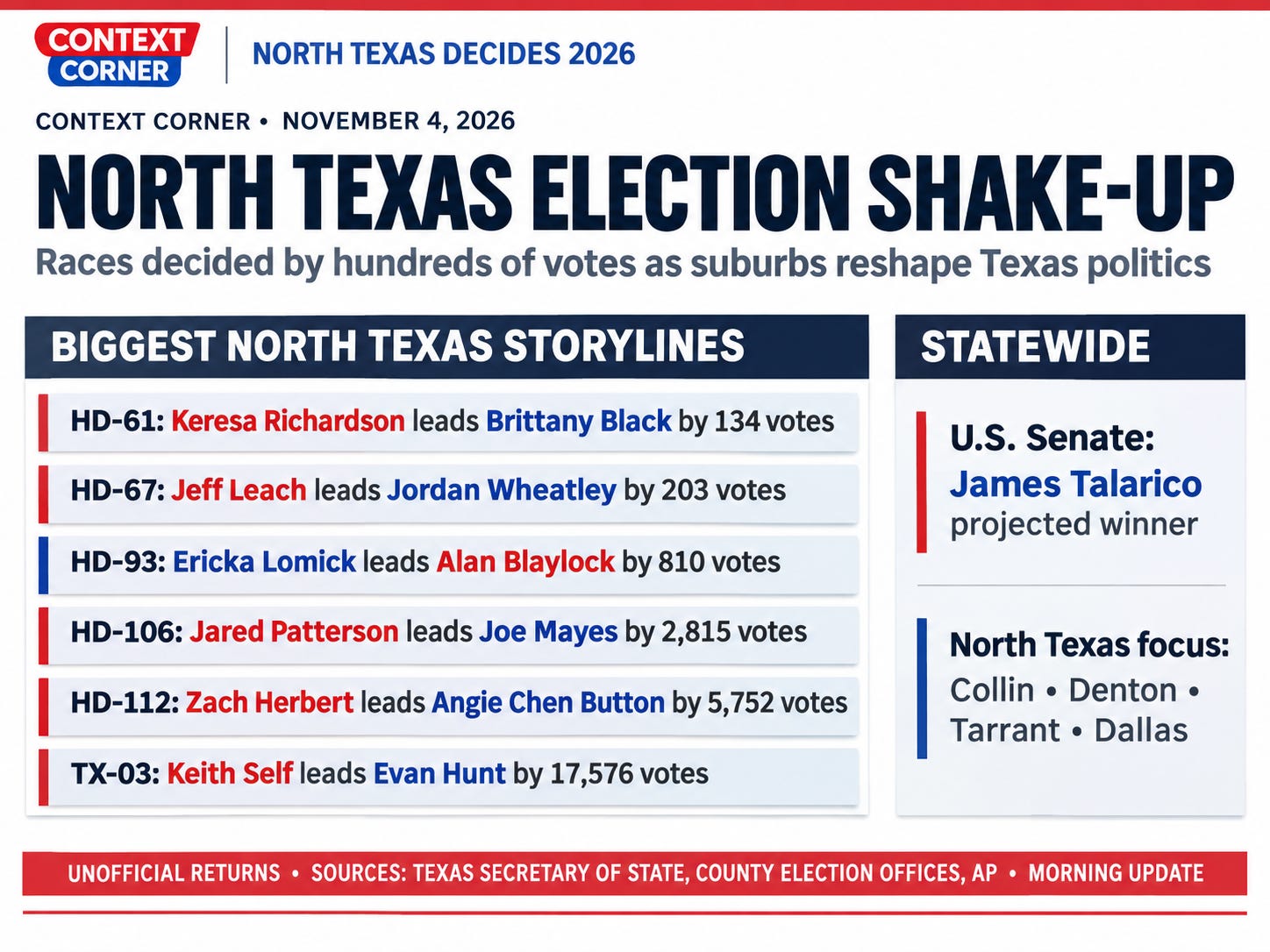
In Texas House District 61, Republican incumbent Keresa Richardson leads Democrat Brittany Black by just 134 votes.
In neighboring District 67, Republican incumbent Jeff Leach leads Democrat Jordan Wheatley by only 203 votes.
Both contests remain unresolved in the unofficial returns reviewed by Context Corner.
Meanwhile, Democrats have won historic statewide victories, with James Talarico projected to defeat Ken Paxton for the U.S. Senate and Gina Hinojosa projected to defeat incumbent Gov. Greg Abbott.
But the results across North Texas tell a more complicated story.
Republicans are maintaining leads in several congressional and legislative districts, while Democrats are proving competitive in suburban communities that have long helped define the state’s Republican political strength.
The emerging picture is not simply red versus blue. It is a region where political representation is becoming increasingly competitive — sometimes down to a few hundred votes.
AT A GLANCE: Six Races Shaping the North Texas Election

HD-61 -Collin- Keresa Richardson (R)-134 votes
HD-67-Collin-Jeff Leach (R)-203 votes
HD-93-Tarrant-Ericka Lomick-(D)-810 votes
HD-63-Denton-Denise Wooten - (D)1,554 votes
HD-106-Denton-Jared Patterson-(R)2,815 votes
HD-112-Dallas-Zach Herbert (D)-5,752 votes
Source: Unofficial election returns reviewed November 4, 2026. Margins may change as additional ballots are processed.
COLLIN COUNTY: The Political Battle Comes Down to Hundreds of Votes
Collin County, encompassing growing communities including McKinney, Plano and Frisco, is emerging as one of the region’s most closely watched political battlegrounds.
Two Texas House races illustrate just how competitive the county has become.
House District 61: A Lead That Changed Overnight
Democrat Brittany Black was leading Republican incumbent Keresa Richardson by just seven votes shortly after midnight.
By Wednesday morning, additional returns had reversed the standings.
Richardson now leads with 44,760 votes, compared with 44,626 for Black.
Green Party candidate Anissa Chilmeran has received 1,692 votes.
The margin between the two leading candidates is approximately 0.15 percentage points.
The result underscores why election-night leads should never be confused with final outcomes.
With such a narrow margin, the remaining ballot-counting and canvassing processes will be especially important.
House District 67: Another Race on a Knife’s Edge
Republican incumbent Jeff Leach has received 42,566 votes, while Democrat Jordan Wheatley has received 42,363.
That is a difference of just 203 votes.
The two candidates are separated by approximately one-quarter of one percentage point.
Elsewhere in Collin County, Republican Matt Shaheen leads Democrat Sandeep Srivastava by 9,314 votes in District 66.
Democratic incumbent Mihaela Plesa maintains a 10,828-vote lead over Republican George Flint in District 70.
The takeaway: Collin County is not moving uniformly toward either political party. Its individual legislative districts are producing sharply different results, including some of the closest contests in Texas.
DENTON COUNTY: A Political Map Moving in Different Directions
In neighboring Denton County, election results reveal a similarly competitive environment.
Republican incumbents maintain leads in several districts, but Democratic challengers have made significant gains elsewhere.
In House District 63, Democrat Denise Wooten leads Republican incumbent Ben Bumgarner by 1,554 votes.
If that lead holds, the seat would change party control.
Meanwhile, Republican incumbent Jared Patterson leads Democrat Joe Mayes by 2,815 votes in House District 106.
Earlier election-night returns showed Mayes ahead by just 25 votes, highlighting how dramatically the picture can change as ballots are counted.
Republican incumbents Mitch Little, Andy Hopper and Richard Hayes also lead their respective contests in the latest returns.
What makes Denton County particularly interesting is the contrast between these races.
While Democrats are competitive in some districts, Republicans continue to demonstrate substantial electoral strength in others.
Rather than a single countywide political shift, the results suggest a patchwork of communities with different priorities and voting patterns.

TARRANT COUNTY: Democrats Challenge Republican Strength
Tarrant County, home to Fort Worth and Arlington, has long played an important role in determining which party performs well in North Texas.
This election is no exception.
Democratic candidates are leading several competitive Texas House races.
In House District 93, Democrat Ericka Lomick leads Republican Alan Blaylock by just 810 votes.
In District 97, Democrat Beth McLaughlin leads Republican John McQueeney by 1,439 votes.
Katie O’Brien Duzan and Ebony Turner also hold Democratic leads in Districts 94 and 96, respectively.
Republicans remain competitive across the county.
David Lowe leads in District 91, while Armin Mizani and Charlie Geren hold advantages in Districts 98 and 99.
One of the most consequential results involves the Texas Senate.
Democrat Taylor Rehmet has been projected to win Senate District 9, defeating Republican Leigh Wambsganss.
His victory adds to the broader picture of Democratic gains in a county where political competition has intensified over successive elections.
Yet Tarrant County remains far from politically uniform.
The results reveal sharply different outcomes from one legislative district to another.
DALLAS COUNTY: Democrats Hold Strong, With a Key Suburban Contest
Dallas County continues to deliver substantial margins for Democratic candidates.
But one of its most consequential legislative races involves a district that has been represented by a Republican.
In House District 112, Democrat Zach Herbert leads Republican incumbent Angie Chen Button by 5,752 votes.
Herbert has received 43,251 votes, compared with 37,499 for Button.
If the result holds, the district would shift from Republican to Democratic representation.
Republican Morgan Meyer, however, maintains a lead in House District 108, demonstrating that Republican candidates remain competitive in parts of Dallas County.
Elsewhere, Democratic incumbents Rafael Anchia, Ana-Maria Ramos, Aicha Davis, John Bryant, Rhetta Bowers, Cassandra Hernandez and Venton Jones hold substantial leads.
Dallas County’s results demonstrate both the strength of the Democratic electorate and the continued political competition in its suburban districts.

TEXAS MAKES HISTORY: TALARIO AND HINOJOSA WIN STATEWIDE
The North Texas results come against a historic statewide backdrop.
Democrat James Talarico has been projected to win Texas’s U.S. Senate race, defeating Republican Ken Paxton.
The victory marks the first time since 1988 that Texas voters have elected a Democrat to the U.S. Senate.
In the governor’s race, Democrat Gina Hinojosa has been projected to defeat Republican incumbent Greg Abbott.
Hinojosa will become Texas’s first Latina governor and the state’s first Democratic governor since Ann Richards.
Both victories represent a major change in Texas politics after decades of Republican dominance in statewide elections.
The results also demonstrate the importance of suburban voters.
Historically Republican-leaning communities across North Texas showed substantial Democratic support in the statewide contests, even while supporting Republican candidates in several congressional and state legislative races.
That distinction matters.
Voters do not necessarily make identical choices across every office on their ballots.
A voter who supports a Democratic candidate for governor may still support a Republican candidate for the Texas House or Congress.
Understanding those differences will be essential to interpreting the election.
TX-03: KEITH SELF MAINTAINS CONGRESSIONAL LEAD
One of North Texas’s most closely watched congressional contests is unfolding in Texas’s 3rd Congressional District.
Republican incumbent Keith Self leads Democrat Evan Hunt by 17,576 votes in the latest state returns reviewed by Context Corner.
Self has received 169,243 votes, compared with Hunt’s 151,667.
Earlier on election night, Hunt held a narrow advantage before additional returns shifted the lead toward Self.
The contest illustrates another important lesson from the election: Democratic victories at the statewide level do not automatically translate into victories in every congressional district.
Other Republican congressional candidates, including Pat Fallon, Lance Gooden and Jake Ellzey, also lead in their respective North Texas districts in the reviewed returns.
The results highlight the importance of examining individual races rather than making assumptions based on statewide outcomes.
WHY THESE RESULTS MATTER TO NORTH TEXAS FAMILIES
It can be tempting to view elections primarily as contests between political parties.
But the people elected to represent North Texas will make decisions that affect residents’ daily lives.
Texas legislators will confront questions about public education funding, property taxes, housing affordability, healthcare access, transportation and the state’s rapidly expanding population.
Local communities will also be watching how their representatives approach civil rights, religious freedom, public safety and economic opportunity.
For families in McKinney, Plano, Frisco, Denton, Arlington, Fort Worth and Dallas, the consequences of these elections will extend well beyond election night.
A representative elected by a margin of 134 votes will have the same legislative responsibilities as one elected by a margin of 30,000 votes.
Both will be expected to represent their entire districts, including residents who voted for someone else.
WHAT HAPPENS NEXT?
Some contests have already been projected by major election decision desks.
Others remain unresolved.
In particularly close races such as House Districts 61 and 67, attention now turns to the remaining ballots, county canvassing procedures and whether the final certified margins warrant further review.
Election officials must complete their legally required processes before results become official.
A narrow margin does not automatically trigger a recount, and an election-night projection is not the same as certification.
THE BIGGER PICTURE
The 2026 election has already changed Texas politics.
But the most revealing story may be unfolding in North Texas’s rapidly growing suburbs.
The region is not voting as a single political bloc.
Some communities are supporting Democrats by substantial margins. Others continue to elect Republicans comfortably. And in several districts, the two parties are separated by only a handful of votes.
The political future of North Texas is not settled.
For residents, that creates both an opportunity and a responsibility: to stay informed, understand who represents them and hold elected officials accountable long after the election signs disappear.
Because while campaigns end on Election Day, the decisions made by those who win will shape these communities for years to come.
HOW TO FOLLOW THE RESULTS
Context Corner will continue monitoring unofficial returns, projected winners and the certification process across Collin, Denton, Tarrant and Dallas counties.
Readers can follow official election information through the Texas Secretary of State and each county’s election administration.
Sources and Editorial Notes
Official election records: Texas Secretary of State; Collin County Elections; Denton County Elections; Tarrant County Elections; Dallas County Elections.
Election reporting: Associated Press, Texas Tribune, NBC News and unofficial election returns compiled from the Texas Secretary of State’s reporting system.
Results reflect the November 4 morning reporting snapshots reviewed for this article. Vote totals and margins are unofficial and subject to change. Projected winners are identified separately from candidates who merely lead in the count.
Context Corner — Independent Nonprofit Journalism for North Texas
Source: Unofficial election returns reviewed November 4, 2026. Margins may change as additional ballots are processed.