


By Samad Rafe
Imagine someone handed you a report detailing everywhere you’ve driven over the past month. The route you take to work. The mosque, church or synagogue you attend each week. The political rally you joined. The doctor’s office you visited. Your child’s school. The coffee shop where you met a friend.
Not because you committed a crime. Not because a judge signed a warrant.
But because every time your vehicle passed a roadside camera, your license plate was scanned, your vehicle identified and your location quietly added to a growing database.
For many Americans, that sounds like something from George Orwell’s 1984.
It isn’t.
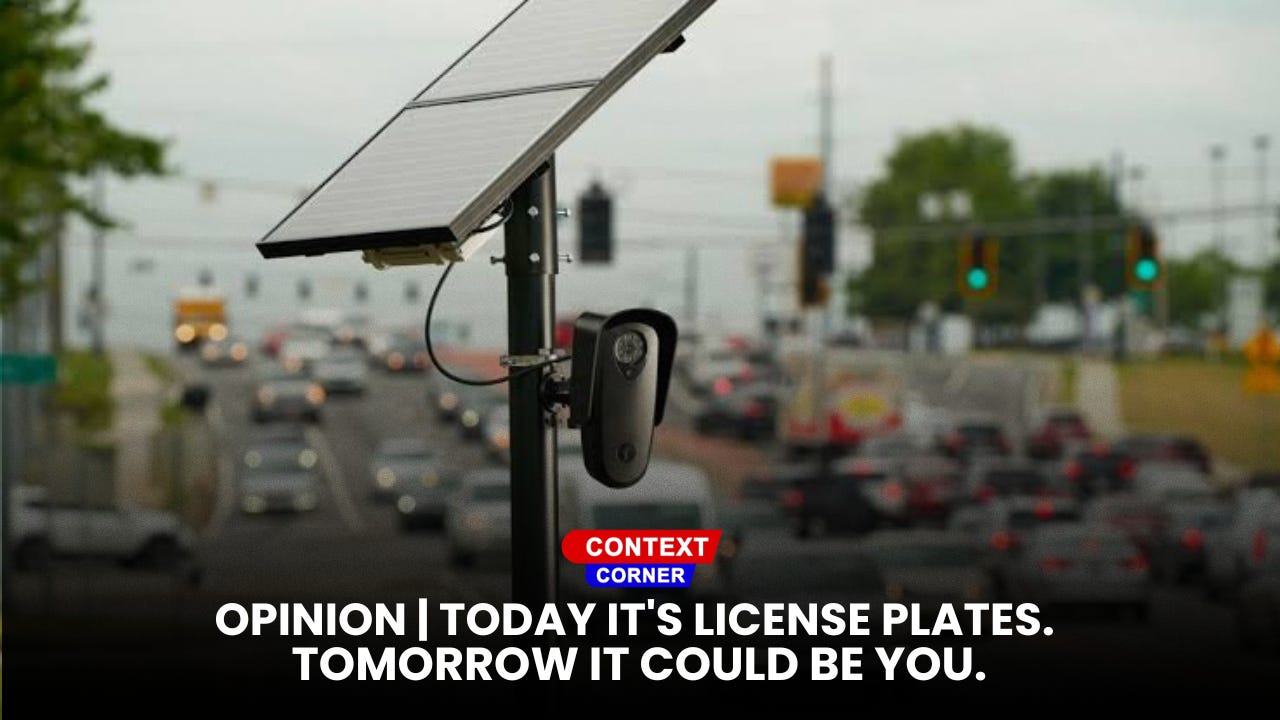
It is increasingly part of the national conversation surrounding Flock Safety cameras, commonly known as Flock cameras, and other automated license plate readers (ALPRs) that are being installed in thousands of communities across America.
These systems have helped police recover stolen vehicles, locate missing children, identify suspects and solve violent crimes. Those achievements are real and should not be dismissed.
But neither should the constitutional questions they raise.
The debate America faces today is not whether surveillance technology works. It is whether the laws protecting our freedoms have kept pace with the technology itself.
A Rare Bipartisan Constitutional Debate
This is no longer a concern raised only by privacy advocates.
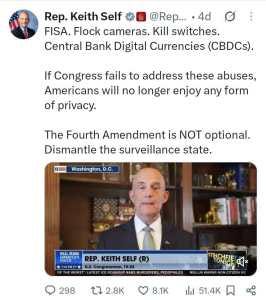
Congressman Keith Self of Texas recently introduced the Privacy Act, arguing that federal agencies should generally obtain a warrant before accessing certain surveillance data.
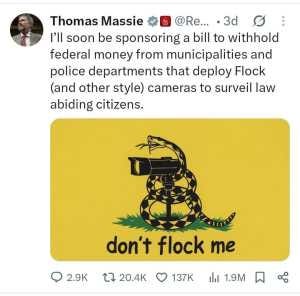
Congressman Thomas Massie of Kentucky has proposed legislation to restrict federal support for jurisdictions using Flock camera systems without stronger privacy protections.
Civil-liberties organizations such as the ACLU and the Electronic Frontier Foundation have also urged lawmakers to establish stricter safeguards governing automated surveillance and location tracking.
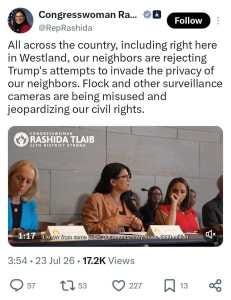
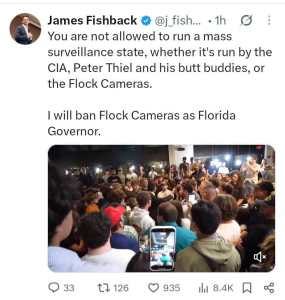
These groups rarely agree on public policy. Yet they are asking many of the same questions.
When constitutional conservatives, civil-liberties advocates and legal scholars begin converging on the same concern, it deserves serious attention.
The Constitution Was Written for Technology That Didn’t Exist
The Founding Fathers never imagined artificial intelligence. They never imagined cloud databases capable of storing billions of records. They never imagined networks of cameras capable of reconstructing where millions of Americans traveled over days, weeks or months. Yet they understood something more important than any particular technology.
Government power expands unless it is restrained. That is precisely why the Fourth Amendment exists. It wasn’t written because the Founders distrusted one particular president or one political party.
It was written because they believed liberty depends upon limiting government authority regardless of who occupies public office.
A police officer observing one vehicle on a public street is not the same as a searchable digital archive documenting the daily movements of millions of innocent people.
Technology has fundamentally changed the scale of government observation. Our constitutional protections should evolve to address that reality.
History Warns Against Waiting Too Long
Some argue Americans shouldn’t worry because today’s surveillance systems are designed to fight crime.
History suggests otherwise.
In the 1960s, the FBI’s COINTELPRO program monitored civil rights leaders, anti-war activists and political organizations, often under the justification of protecting national security and public order. Among those targeted was Dr. Martin Luther King Jr., whose communications and activities were extensively monitored.
The issue was not the technology of the era.
It was the absence of sufficient safeguards against government overreach.
That lesson became even clearer after the Church Committee investigation in 1975. Following extensive Senate hearings into the activities of intelligence agencies, lawmakers concluded that unchecked surveillance powers posed a profound threat to constitutional liberty. The committee warned that if left without meaningful oversight, those powers could become instruments of “total tyranny.”
Those findings reshaped surveillance laws for an earlier generation.
Today’s technology demands that Congress ask the same constitutional questions once again.
Privacy Is About Freedom, Not Secrecy
Whenever surveillance is debated, one phrase inevitably appears:
“If you have nothing to hide, you have nothing to fear.”
It sounds reasonable. It is also incomplete. Privacy has never been about hiding wrongdoing. It is about protecting lawful freedom.
The freedom to attend religious services without creating a permanent government record. The freedom to participate in political movements without wondering who may someday analyze that information. The freedom to meet journalists, lawyers, physicians or community leaders without every movement becoming searchable data.
The First Amendment protects our freedom to worship, assemble and speak.
Those freedoms are strongest when citizens can exercise them without unnecessary government monitoring.
Public Safety and Privacy Are Not Opposites
This debate should not be framed as choosing between police and privacy.
America can have both.
Law enforcement should absolutely have effective tools to investigate kidnappings, recover stolen vehicles and arrest dangerous criminals.
Communities deserve to be safe. Victims deserve justice.
But constitutional government has always required more than effective policing. It requires limits on government power.
Public safety and individual liberty are not competing values. They are both essential to a free society.
The Privacy Act Is a Beginning—Not the Finish Line
Congressman Keith Self deserves credit for recognizing that surveillance laws require modernization.
Requiring warrants before accessing certain surveillance databases reinforces an important constitutional principle. But access is only one part of the equation.
Congress should also ask:
How long should data on innocent Americans be retained?
Should agencies publicly disclose how often these databases are searched?
What penalties should exist for unauthorized access?
Should surveillance information be freely shared across agencies?
Should historical location data require judicial approval except in genuine emergencies?
Should independent audits verify compliance with privacy protections?
These questions deserve answers before surveillance technology becomes even more sophisticated.
Not afterward.
Tomorrow’s Government Matters Too
America’s constitutional system was never built on the assumption that government officials would always exercise perfect judgment. It was built on the understanding that every generation must place reasonable limits on government power.
Today’s elected officials will not govern forever. Neither will tomorrow’s.
The laws enacted today will outlast both. Artificial intelligence will continue advancing. Camera networks will become more capable. Data analytics will become more powerful.
The question is not whether surveillance technology will evolve. It will.
The question is whether constitutional protections will evolve alongside it.
Keith Self’s Privacy Act begins an important national conversation.
Congress should continue it—not because Americans oppose technology, and not because they oppose law enforcement, but because history teaches that freedom is best preserved when government power grows more slowly than the technology it seeks to use.
Because liberty is rarely lost in a single dramatic moment. It is more often surrendered one small exception at a time.
Today it’s license plates. Tomorrow, it could be you.