


By Context Corner | November 9, 2026
AUSTIN, Texas — Texas education officials spent months debating how public-school students should learn about Islam. Muslim parents objected. Historians questioned the accuracy of disputed passages. Even some of the state’s own curriculum advisers raised concerns.
The Republican-controlled State Board of Education approved the controversial language anyway.
Then came the November 3 election.
Voters dramatically reshaped the 15-member board, reducing what had been an 11–4 Republican majority to a chamber in which control could hinge on a single, exceptionally close race.
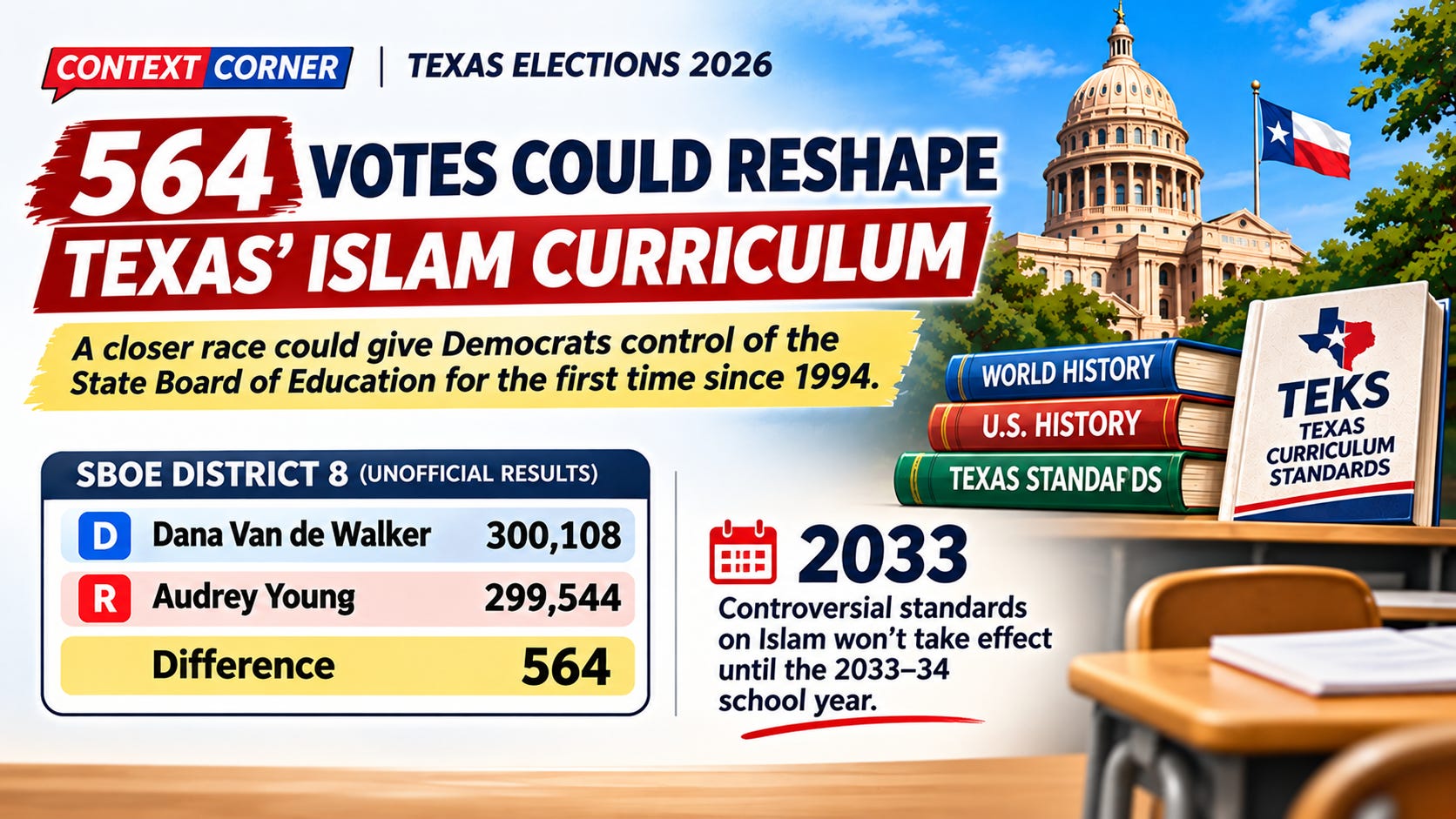
In State Board District 8, Democrat Dana Van de Walker leads Republican incumbent Audrey Young by just 564 votes, according to unofficial results published by the Texas Secretary of State.
The outcome could give Democrats an 8–7 majority — their first control of the board since 1994 — or leave Republicans with a much narrower majority than they held when the standards were approved.
But the biggest surprise may be what happens next.
The disputed high-school standards are not scheduled to enter classrooms until the 2033–34 school year.
That gives future board members years to reconsider what Texas approved in 2026.
The question is no longer simply whether the state should have adopted the language.
It is whether the election has created a realistic opportunity to change it before implementation.
What Texas approved about Islam
The controversy centers on the Texas Essential Knowledge and Skills, commonly called TEKS — the state standards that identify what students are expected to learn.
They are not individual classroom lesson plans. Teachers and districts retain instructional responsibilities, but the standards influence curriculum development, textbooks and instructional materials.
During the 2026 social-studies revision process, the State Board approved language that critics say portrays Islam disproportionately through warfare, conquest, slavery and terrorism.
One World History expectation describes the Prophet Muhammad’s “brutal military campaigns against Jewish and Christian tribes” and discusses slavery and female captives in the context of early Islam.
Another addresses jihad and the historical expansion of Islamic rule.
In U.S. History, the revised standards attribute the September 11, 2001 terrorist attacks to “radical Islam.” Other provisions address extremist organizations including al-Qaeda and ISIS.
Muslim Texans who testified against the language argued that students should learn an accurate, contextualized history of Islam, including the contributions of Muslim societies to civilization.
The dispute was not necessarily over whether students should learn about religious conflicts, slavery, jihad or terrorist organizations.
It was over how those subjects were framed — and whether similar historical standards were being applied to other religions and civilizations.
Even the state’s own advisers raised concerns
The objections extended beyond the Muslim community.
Andrea Hutchison, a social-studies curriculum coordinator for Prosper Independent School District in North Texas, questioned the historical reliability of one characterization of early Islam.
She said it did not “hold up to close historical scrutiny.”
Robert Koons, a University of Texas at Austin philosophy professor who also served as a content adviser, questioned the reliability of some sources supporting the language.
At least three appointed content experts raised concerns about the portrayal of Islam, according to The Texas Tribune.
The board nevertheless approved the disputed provisions.
A revealing moment came during deliberations when Republican member Will Hickman sought to remove the word “brutal” from the description of Muhammad’s military campaigns.
His reasoning was that wars and military battles are generally brutal, yet the standards did not describe other historical campaigns in the same way.
His proposal was rejected.
For critics, the episode illustrated the central question: Was Texas presenting history consistently, or applying different language when discussing Islam?
Supporters of the broader curriculum revision maintained that the state needed stronger historical instruction, a clearer chronological framework and greater emphasis on American and Western civilization.
The State Board’s Republican leadership defended the overall rewrite as an effort to identify essential historical knowledge rather than overload classrooms with too many expectations.
That disagreement is likely to return if the new board reopens the standards.
How 564 votes could reshape Texas education
Before the November election, Republicans held 11 of the board’s 15 seats.
That majority gave them considerable room to advance major changes even when Democratic members and some Republicans disagreed.
The new board will be very different.
With 14 seats decided, Democrats and Republicans each hold seven.
The final seat, District 8, remains unresolved.
The Texas Secretary of State’s unofficial results show:
Dana Van de Walker, Democrat: 300,108 votes
Audrey Young, Republican: 299,544 votes
Margin: 564 votes
All polling locations are reporting, but certification and any potential recount still matter. Young has not conceded, according to post-election reporting.
If Van de Walker wins, Democrats would hold an 8–7 majority.
If Young ultimately prevails, Republicans would retain control by the same narrow margin.
Either result would mark a fundamental departure from the board that adopted the controversial standards.
An 8–7 Republican majority would require near-unanimous party agreement on closely divided votes. Republican Pam Little of Fairview, for example, has previously departed from Republican colleagues on contentious education questions.
A Democratic majority could create a different set of priorities altogether.
Yet a change in partisan control would not guarantee that the standards would be rewritten.
That would still require formal board action.
The fact many parents may not know: The standards are years away
The Texas Education Agency’s implementation schedule provides a critical distinction between adoption and classroom implementation.
Although the State Board approved the standards in 2026, most high-school social-studies courses are not scheduled to begin using them until the 2033–34 school year.
The state has established a staggered rollout:
School levelScheduled implementationKindergarten–Grade 52030–31Grade 62031–32Grades 7–82032–33Most high-school social-studies courses2033–34
Applied Personal Financial Literacy follows a separate, earlier schedule.
This distinction matters.
A standard can be officially adopted and legally effective years before schools are required to implement it.
The state uses that period to prepare instructional materials, align curricula and provide educators with professional development.
It also creates a window in which policymakers could reconsider the disputed provisions.
Several State Board elections may occur before the high-school standards enter classrooms.
For families who opposed the 2026 language, that means the adoption vote may not be the end of the debate.
It does not mean revisions are guaranteed.
It means there is time — and a government body with the authority to revisit its previous decisions.
Can the next board actually rewrite the standards?
Yes, although the process is more complicated than simply taking a new vote.
The State Board establishes Texas curriculum standards through its legal rulemaking authority.
A future board can revisit those standards, but amendments would ordinarily require formal consideration, proposed language, public participation and compliance with applicable rulemaking procedures.
Texas’ public rulemaking process also provides opportunities for interested Texans to submit comments and testify.
The key decision would be how broadly to reopen the curriculum.
One approach would be a targeted revision addressing disputed descriptions of Islam while leaving the rest of the new social-studies framework intact.
Another would be a wider reconsideration of the standards.
The first approach could be more manageable for a narrowly divided board, but whether members would support it remains unknown.
For example, a future board could consider whether U.S. History standards should identify al-Qaeda and its extremist ideology more specifically when discussing the September 11 attacks.
It could also examine whether lessons on early Islamic civilization provide sufficient context concerning political history, warfare, religious development, science, mathematics, medicine, philosophy and culture.
Those are possible areas for discussion, not proposals the incoming board has formally adopted.
The unanswered question is whether enough members will make revisiting these provisions a priority.
A new governor could influence the board’s leadership
The November election changed another important office.
Democrat Gina Hinojosa defeated Republican Governor Greg Abbott, according to Associated Press election reporting.
As governor, Hinojosa will have the authority to appoint the State Board of Education’s chair from among its elected members, subject to confirmation by the Texas Senate.
The chair cannot unilaterally rewrite curriculum standards.
But leadership can influence the board’s direction, internal deliberations and priorities.
If Democrats gain control of the board, the combination of a new majority and a new governor could change the political environment surrounding Texas education policy.
Even if Republicans narrowly retain the board, the incoming governor’s appointment authority could still affect its leadership.
Whether that translates into a formal reconsideration of the Islam-related standards remains to be seen.
Why this debate matters in North Texas
Although the disputed standards were approved in Austin, North Texas is directly connected to the debate.
Andrea Hutchison, one of the advisers who questioned the language, works for Prosper ISD, which serves families in Collin and Denton counties.
Republican board member Pam Little is from Fairview in Collin County.
And Democratic board member Tiffany Clark, whose district includes parts of the Dallas–Fort Worth area, will serve on the newly configured board.
For families in Plano, Frisco, McKinney, Richardson, Irving, Arlington, Dallas and Fort Worth, the debate raises questions that extend beyond a single religious community.
What historical standards should public schools use when teaching about religion?
Should students learn about the violence and conflicts associated with every civilization using consistent terminology?
How should textbooks distinguish between religious beliefs, historical empires, political movements and modern extremist organizations?
And who should decide whether the curriculum fairly represents a community’s history?
Muslim parents have a particular stake in how their faith is portrayed to classmates who may have little other exposure to Islam.
But the larger question concerns the accuracy and fairness of public education for every Texas student.
The next battle could be over textbooks
Even if the next board does not immediately reconsider the standards, it will have other significant responsibilities.
Among them is the review and approval of instructional materials.
State standards determine what students are expected to know. Instructional materials help shape how that knowledge is presented in classrooms.
This creates two separate decisions.
The board could revisit the wording of the TEKS themselves.
It could also influence future decisions about whether textbooks and educational materials adequately align with those standards.
Those processes have different legal and practical limitations. Approval of instructional materials does not give the board unrestricted authority to disregard the TEKS.
But both processes can influence the educational experience students eventually receive.
That makes future board meetings important even if no immediate effort to rewrite the standards begins.
What should parents watch now?
There are three developments that could determine the direction of the debate.
First, the District 8 election. Certification and any possible recount will settle whether Democrats or Republicans control the board.
Second, the new board’s agenda. Members will have to decide whether to place the adopted social-studies standards back under consideration.
Third, the public process. If revisions are proposed, parents, teachers, scholars and other Texans may have opportunities to provide written comments and public testimony.
Families do not need to wait until 2033 to understand or participate in the process.
The Texas Education Agency and State Board publish meeting agendas, rulemaking materials and information on public participation.
Those records will be central to determining whether the new political balance results in actual policy changes.
Texas made its decision. The election may have reopened it.
In September, the disputed high-school standards appeared settled.
The State Board had approved them despite months of criticism.
The debate over how Islam would be presented in future Texas classrooms seemed to have reached its conclusion.
Then voters reshaped the institution responsible for those decisions.
Today, control of that institution may depend on 564 votes.
But the most consequential fact is not the margin alone.
It is that the standards at the center of the dispute are not scheduled for high-school implementation until 2033.
The new board may decide to leave the language unchanged.
It may attempt narrow revisions.
Or it may reopen a larger debate about how Texas teaches religion and world history.
For now, there is no announced decision to reverse the provisions.
What has changed is the possibility.
The standards have been adopted. They have not yet reached the classrooms for which they were written.
And the people who will ultimately decide their future may no longer be the same people who approved them.
What to watch next
Certification or a potential recount in State Board District 8.
Appointment of the next State Board chair.
New board members’ positions on revisiting the 2026 standards.
Future social-studies rulemaking and textbook adoption proceedings.
Sources and further reading
Texas Secretary of State — November 2026 unofficial election returns: https://electionresults.sos.state.tx.us/results.html
Texas Education Agency — Social Studies standards and implementation schedule: Social Studies | Texas Education Agency
Texas State Board of Education — 2025–26 social-studies revision documents: https://sboe.texas.gov/state-board-of-education/teks/social-studies-teks-review-2025
Texas Tribune — August 31, 2026 reporting on the disputed standards: Texas board OKs anti-Islamic rewrite of Texas social studies
Texas Tribune — November 2026 State Board election developments: Texas Dems celebrate flipping State Board of Education, brace for recount
Editor’s note: Election figures are unofficial as of November 9, 2026, and may change during canvassing, certification or a recount. The article distinguishes current adopted standards from future implementation requirements. Context Corner will update this report if the election result or board policy changes.